18 Entry and the Logic of Deterrence
18.1 Entry Is a Forecast About Equilibrium
Entry is not a leap into the unknown.
It is a forecast.
Specifically, entry is a forecast about post-entry equilibrium profit.
When an entrepreneur considers entering a market with an incumbent, the relevant question is not:
- Is demand large?
- Is the market growing?
- Is the product exciting?
The question is:
What will equilibrium profit look like after entry?
Competition analytics provides that forecast.
Using estimated demand parameters and cost structures, you can compute:
- Equilibrium price
- Equilibrium quantity
- Equilibrium profit
If expected equilibrium profit is negative, entry destroys value.
If it is positive and durable, entry may be justified.
Entry is therefore not primarily about optimism.
It is about equilibrium arithmetic.
18.2 What Entry Barriers Really Are
Traditional strategy language speaks of entry barriers.
Patents.
Brand loyalty.
Scale economies.
Switching costs.
These are often described as walls that keep competitors out.
But analytically, an entry barrier is something simpler.
An entry barrier is structural asymmetry that produces negative expected equilibrium profit for the entrant.
Entry is deterred when, given estimated demand and cost parameters, the entrant’s equilibrium profit is zero or negative.
No mysticism is required.
If the incumbent enjoys:
- Higher baseline demand (\(\mathsf{a}\)),
- Lower own-price sensitivity (\(\mathsf{b}\)),
- Favorable substitution asymmetry (\(\mathsf{d_{ij} > d_{ji}}\)),
- Or lower variable cost (\(\mathsf{c}\)),
then equilibrium may leave the entrant with insufficient margin.
That is an entry barrier.
It is not a slogan.
It is a parameter configuration.
18.3 Why Entry Happens Anyway
If entry barriers are structural, why does entry occur so often?
Because entry deterrence requires a high level of cognition.
For deterrence to work, potential entrants must:
- Correctly anticipate post-entry equilibrium.
- Believe the incumbent’s structural advantages.
- Trust the arithmetic of profit under rivalry.
Most do not.
Entrepreneurs routinely:
- Overestimate baseline demand,
- Underestimate substitution,
- Ignore cost disadvantage,
- Assume competitors will remain passive.
Optimism substitutes for computation.
Entry occurs not because barriers are absent, but because equilibrium is misestimated.
Competition analytics reduces this cognitive error.
18.4 Strategic Deterrence and Commitment
Incumbents can attempt to shape entry expectations.
They may:
- Invest in visible capacity,
- Signal low cost,
- Commit to aggressive pricing,
- Increase switching costs.
These actions do not “block” entry mechanically.
They alter the expected equilibrium parameters.
If a potential entrant believes:
- The incumbent’s cost is structurally lower,
- Substitution will be severe,
- Price discipline will be intense,
then expected equilibrium profit falls.
Entry is deterred not by fear alone, but by forecasted loss.
Deterrence is credible only when structural asymmetry is real — or convincingly signaled.
18.5 The Entrepreneurial Entry Test
Before entering a competitive market, compute:
- Your expected equilibrium profit.
- The incumbent’s expected equilibrium profit.
- The magnitude of structural asymmetry.
Then ask:
Does equilibrium leave enough profit for both firms?
If not, one firm will suffer.
If you are the structurally weaker firm, entry is unlikely to be worth doing.
Entry is not bravery.
It is arithmetic under rivalry.
Measure the structure.
Compute the equilibrium.
Then decide whether entry is worth doing.
18.6 Cognition and Entry Performance
The analysis in this chapter assumes that entrepreneurs correctly forecast competitive equilibrium. That assumption is not trivial.
Entry is not just a bet on demand. It is a forecast about how the market will settle after rivals respond.
Different cognitive representations of competition produce systematically different industry outcomes.
In related research,1 we simulated entry decisions for two innovators deciding whether to enter a differentiated market. Each pair used a shared cognitive framework to guide its decision.
Some firms:
- Always entered when demand appeared positive.
- Considered market size but ignored rivalry.
- Considered rivalry but not strategic commitment.
- Applied traditional finance tools (NPV).
- Applied strategic tools (game theory).
- Applied flexibility logic (real options).
- Integrated competitive equilibrium and flexibility into a shared structural representation.
Each cognitive regime produced a distinct pattern of industry profit.
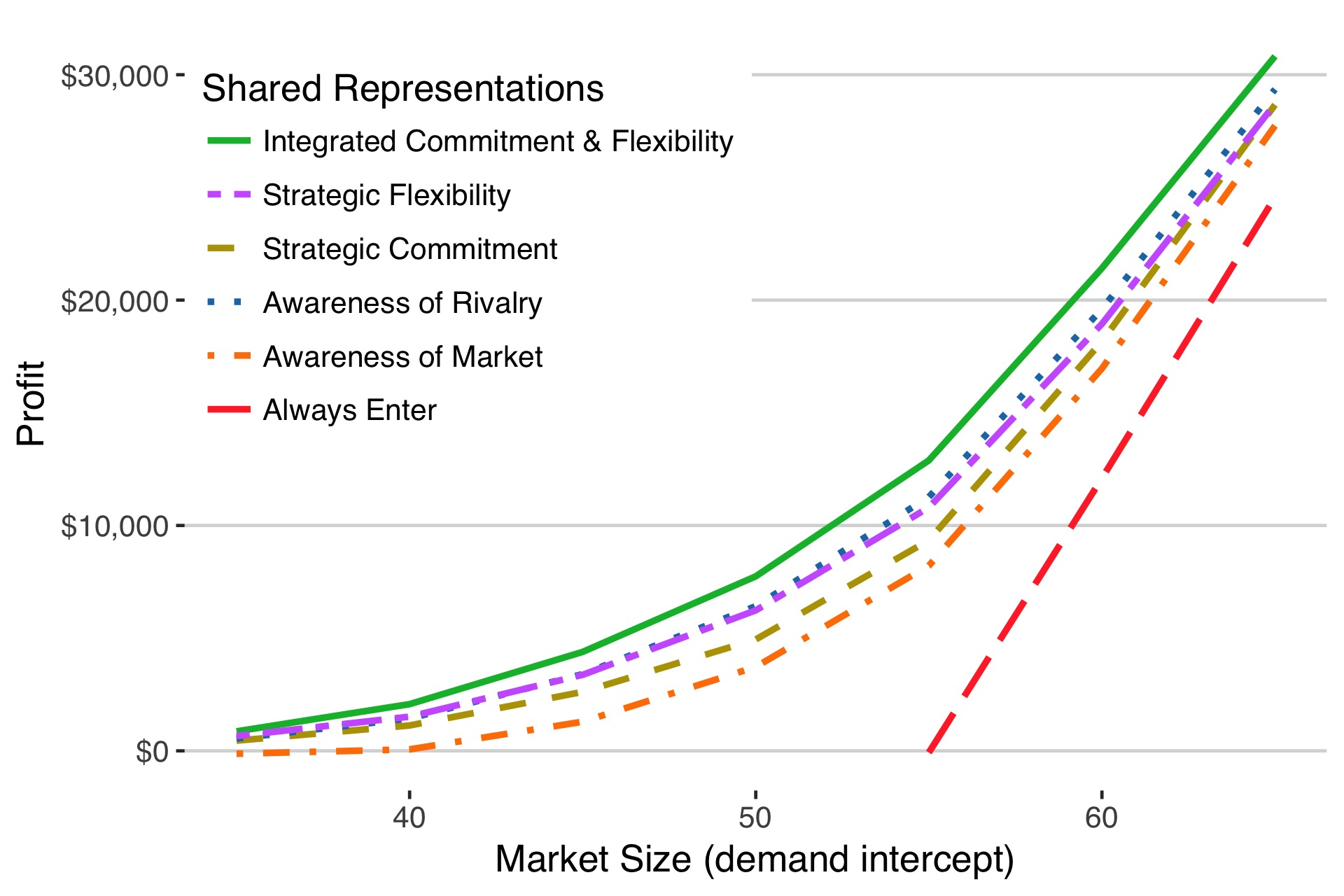
The differences are not subtle.
“Always enter” cognition performed worst.
Recognizing market size improved outcomes slightly.
Recognizing rivalry improved them further.
But the largest performance gain came from explicitly modeling differentiated competition.
When firms forecast equilibrium under differentiated rivalry before entering, profit outcomes rose dramatically.
More sophisticated integrations of game theory and flexibility performed best — but the incremental improvement beyond disciplined competitive equilibrium thinking was modest relative to the leap from naïve entry.
The implication is practical.
Even without advanced strategic machinery, representing competition structurally — estimating demand, modeling substitution, computing equilibrium — moves decision quality near the performance frontier.
In contrast, relying on optimism, market size alone, or isolated financial tools systematically underperforms.
The difference is not intelligence. It is representation.
Entry is a forecast about equilibrium. The quality of that forecast determines performance.
This book develops the discipline required to make that forecast explicit.
Not perfectly.
But structurally.
And that shift alone changes outcomes.
Cognition shapes equilibrium.
Tools are not neutral.
Analytical discipline is competitive advantage.