18 Moves You Cannot Take Back
A commitment changes what your rival does; anything else is a purchase
The last chapter ended with an escape route and no directions. When two firms are stuck in a game that pays neither of them, the way out is to change what the other one expects. This chapter is how, and there is a test that tells you whether you have managed it.
The test earns its place because the difference is genuinely hard to see from the inside. Two firms can make the same investment, at the same price, for the same reason, and for one of them it changes the competition while for the other it is a bill. What separates them is not the size of the cheque.
Saying So Does Not Work
Start with the version firms reach for first, because it is free.
Hogi Yogi, tired of losing, announces that it will match any price Smart Cookie sets and undercut it by a nickel. Smart Cookie should check whether that means anything.
Hogi Yogi’s cost is fifty cents a sandwich. Against Smart Cookie’s price of $1.53, the announced policy would commit Hogi Yogi to $1.48. But Hogi Yogi’s own best response to $1.53 is $1.02, and $1.02 earns it more than $1.48 would. On the day, Hogi Yogi would quietly not do it.
That is a non-credible threat, and spotting one is arithmetic rather than judgment. Work out what the threatening firm earns by following through, and what it earns by forgetting the whole thing. If the second number is larger, nothing was said.
Non-credible threat — a stated intention the firm would not want to carry out if tested. It changes nothing, because the other side can check the arithmetic as easily as you can.
Notice exactly what failed. Hogi Yogi tried to change Smart Cookie’s expectations by talking, while leaving its own situation untouched. Nothing about Hogi Yogi’s incentives moved, so nothing about Smart Cookie’s beliefs needed to.
The Test
A commitment is the move that fixes that. It is irreversible, it changes what you will later want to do, and because of that it changes what your rival should expect from you.
Commitment — an irreversible move that changes what you will later want to do, and is therefore believed. Often called strategic commitment, to keep it apart from the everyday sense of being determined. Determination is not a commitment; a signed lease is.
Which turns into a question you can actually answer about any irreversible move in front of you.
Does my rival’s best response change if I make this move?
Work out what your competitor does if you sit still, and what they do if you go ahead. If the answer is the same either way, the move may still be worth making, and it is a purchase, to be judged on its own returns like any other. If the answer differs, you have changed the game, and the equilibrium worth evaluating is a new one.
That test is the chapter, and it says nothing about who goes first. What makes a commitment work is that it cannot be undone, not that it happened early. An announcement a year in advance changes nothing; a freezer installed this morning changes everything. Order matters only in that your rival has to be able to see it before choosing.
Notice how the work divides, because it is the same division this book has been making since the demand chapters. Computing a rival’s best response under two different structures is arithmetic. Hand over the estimated demand system, the two cost structures, the move and what it changes, and any competent AI will return both answers — and, more usefully, the price at which the answer flips, which is the number you actually want.
What no machine can supply is the specification. Which irreversible moves are genuinely available to you. Whether the one you are considering is irreversible in fact rather than in intention. Which parameter it moves, and by how much. Every one of those is a judgment about your own situation, they all have to be made before any arithmetic can begin, and getting them wrong produces a computation that is flawless and useless.
Running the Test
Hogi Yogi can install equipment that cuts its cost per sandwich from fifty cents to thirty-five. It must be bought before any pricing happens, and it cannot be returned.
Hold Smart Cookie still for a moment, only to see what the move does on its own.
Hogi Yogi
|
Smart Cookie
|
||||
|---|---|---|---|---|---|
| HY unit cost | HY price | HY profit | SC price | SC profit | |
| Before | $0.50 | $1.02 | $0.96 | $1.53 | $1.33 |
| After the equipment | $0.35 | $0.94 | $1.22 | $1.43 | $0.99 |
| Change | -$0.15 | -$0.08 | $0.26 | -$0.11 | -$0.34 |
Read it as a chain rather than a table. Cheaper to make means cheaper to sell, so Hogi Yogi’s price falls from $1.02 to $0.94. Smart Cookie has to follow it down, from $1.53 to $1.43. And Smart Cookie’s profit falls from $1.33 to $0.99 — not because anything happened to Smart Cookie’s costs, which never moved, but because its rival became cheaper and it had to answer.
That is the first move in this whole part that takes something from the other firm, and the reason is a number from the differentiation chapter. Smart Cookie’s demand responds to Hogi Yogi’s price with a coefficient of 5.57, the largest in the system. Smart Cookie is enormously exposed to what Hogi Yogi charges. Neither kind of advertising reached that exposure; a cost cut goes straight at it.
Now let Smart Cookie move, and run the test. The equipment is available to it too, so the question is what Smart Cookie does in each case, and the answer turns out to depend on what the equipment costs.
| If the equipment costs | Smart Cookie, if Hogi Yogi sits still | Smart Cookie, if Hogi Yogi installs it | So the move is |
|---|---|---|---|
| $0.12 | installs | installs | a purchase |
| $0.22 | installs | does not | a commitment |
At twelve cents the equipment is cheap enough that Smart Cookie installs it either way. Hogi Yogi installing it changes nothing about what Smart Cookie does. Both firms end up cheaper, nobody is deterred, and Hogi Yogi has bought a cost reduction — a perfectly good thing to buy, which did not change the game.
At twenty-two cents the answers split. If Hogi Yogi sits still, Smart Cookie buys the equipment. If Hogi Yogi installs it first, Smart Cookie no longer wants to, because matching a rival who is already cheap is worth less than matching one who is not. Hogi Yogi’s move has stopped Smart Cookie doing something it would otherwise have done.
That is where order finally does some work, and it is easiest to see as a sequence.
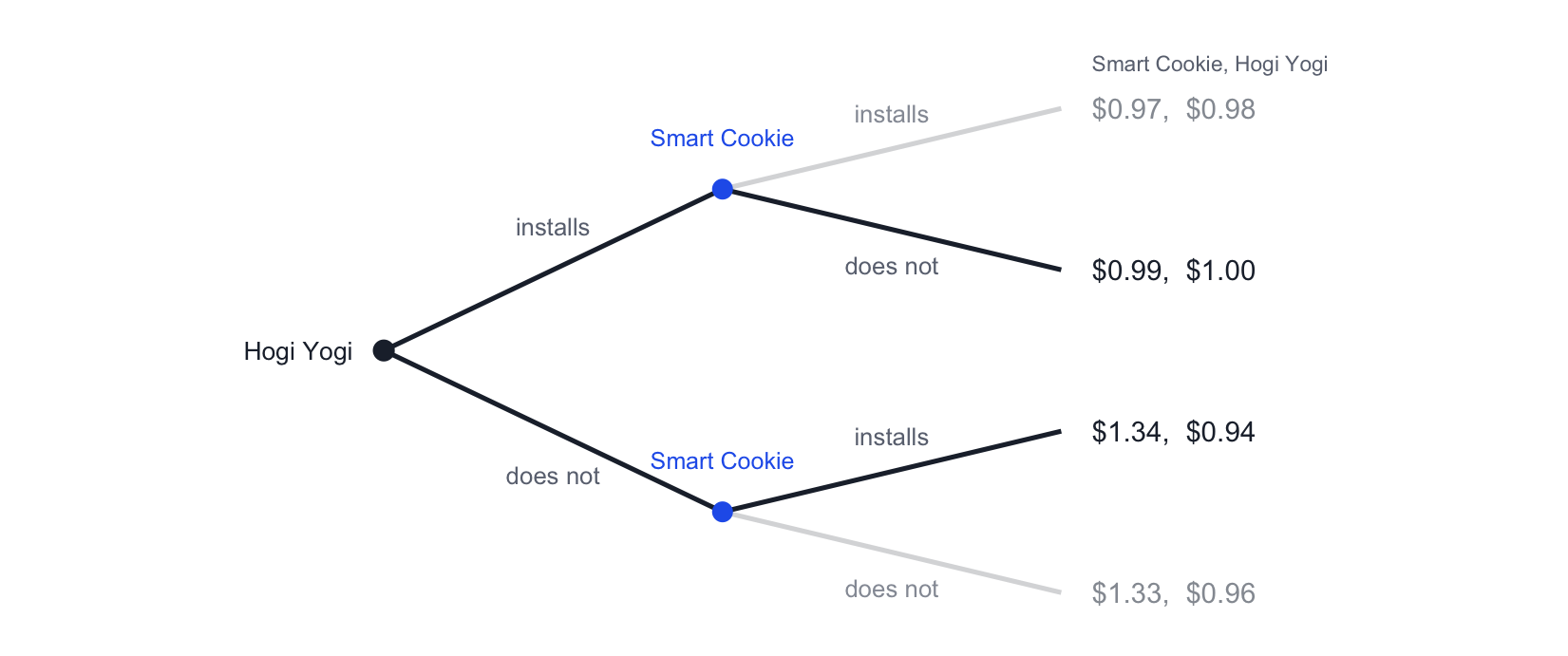
Read it backwards, which is the only way a tree can be read. In the upper branch, where Hogi Yogi has installed the equipment, Smart Cookie compares $0.97 against $0.99 and does not install. In the lower branch, where Hogi Yogi has not, Smart Cookie compares $1.34 against $1.33 and does install. Two different answers, which is the test passing.
Knowing that, Hogi Yogi compares the two outcomes it can actually reach: $1.00 by installing, $0.94 by sitting still. It installs. And Smart Cookie, which would have been a low-cost firm in the other branch, stays at seventy-five cents a sandwich.
What It Actually Bought
Be precise about the gain, because it is not simply money.
At twelve cents both firms invest and Hogi Yogi finishes at $1.08, which is more than the $1.00 it earns at twenty-two. On this period’s profit alone, Hogi Yogi should prefer the cheaper equipment.
What the cheaper equipment does not buy is a position. Both firms end at low cost, neither holds anything the other lacks, and the structural asymmetry that the chapter on advantage called the whole of competitive advantage has been competed away in a single round. At twenty-two cents Hogi Yogi is the only low-cost firm in the market and remains so while the equipment stays expensive.
That is the trade a commitment offers and it is not the one people expect. It rarely maximizes this period’s profit. It buys a structure that persists, by taking an option away from somebody else.
What Counts as a Commitment
The equipment was one example, and one example is a poor basis for recognizing a category. It is worth seeing the range, because the question a reader is left with otherwise is whether their own situation contains anything that qualifies.
The table below is ordered by how hard each move is to reverse, which is the property that decides whether it works at all. The moves near the top bind you tightly and are believed for that reason. The ones near the bottom bind you loosely, and a rival who notices that will treat them as talk.
| The move | What makes it stick | What it changes for the other firm |
|---|---|---|
| Equipment or a process that cuts your unit cost | installed, and it does not go back | at the right price, it stops them matching |
| Capacity built ahead of demand | the capacity exists whether you fill it or not | they expect low prices, because low prices are now your best answer |
| Exclusive supply or distribution agreements | a contract with a term and a penalty | their reach falls, and so does their route to your customers |
| Specialising hard for one segment | rebuilding for a different one costs what building this one cost | your customers are stickier and you are harder to follow |
| Long-term contracts with customers | the customer is bound rather than persuaded | there are fewer customers left for them to win |
| A published price you would be embarrassed to move | reputation, which is real but cheap to spend | very little, unless they believe the embarrassment |
Two things about that table are worth more than its contents.
The middle column is the one to read first. Every row is believed for a specific, checkable reason, and the reason is never that the firm meant it. When you are considering a move of your own, that column is the sentence you have to be able to write.
And nothing in the left column is automatically a commitment. A lease can be one, and usually is not. Capacity can be one, and is not if a rival knows you would rather idle it than fight. Which row a move sits in tells you how likely it is to bind; only the test tells you whether it does.
The Same Thing, Seen From Outside
There is a category of commitment the book has already covered under a different name, and it is worth joining them up.
The chapter on advantage defined an entry barrier as structural asymmetry large enough to make an entrant’s equilibrium profit negative, and observed that an incumbent investing in visible capacity or signalling low cost is not frightening anybody — it is changing their forecast. That is this chapter’s test with one substitution. The rival’s move is enter, and the commitment works if it changes that move to do not.
So entry deterrence is not a separate topic from strategic commitment. It is the special case where the response you are trying to change is the decision to show up at all, and the reason it gets its own literature is that the rival in question does not exist yet and cannot be observed. Everything else about it is the same: an irreversible move, a rival recomputing, and a best response that flips or does not.
That symmetry is worth carrying in both directions. When you are the incumbent, your commitments are barriers. When you are the entrant, somebody else’s commitments are what you are computing your way past, and the question in that same chapter, is the asymmetry real, is the same question as did they actually commit.
When Commitment Backfires
The property that makes a commitment work is the one that makes it dangerous, so the failures are predictable.
It stops responding to news. A commitment is priced on today’s estimate and binding under tomorrow’s. The equipment does not care that enrolment fell. That is the sunk cost trap arriving from the front rather than the rear: not throwing good money after bad, but having removed your own ability to stop.
It invites the response it was meant to forestall. A commitment only works if the rival sees it, and a rival who sees it has time to prepare. The same equipment deters Smart Cookie at twenty-two cents and provokes it at twelve, and the difference is a price Hogi Yogi does not set.
It spends flexibility, which is worth most when you know least. Flexibility here is what the cost chapter meant in arguing that when you commit matters more than how much: the ability to wait, learn, and decide later on better information. A commitment converts that option into an obligation. Where demand is well understood the option was cheap and the trade is fine. Where demand is barely understood, you have paid for predictability with your ability to be wrong safely, which is the one thing a pre-revenue venture cannot spare.
Flexibility — the ability to decide later, once you know more. Worth most when uncertainty is highest, which is exactly when a commitment costs the most to make.
No formula settles that trade. There is, unexpectedly, evidence about what tips it.
What Your Rival Believes
Recall the simulated entry decisions from the chapter on advantage, where each firm held some representation of its market and its rival. Two results land directly on this chapter.1
The first is about what makes a competitor dangerous. A rival that perceives well, reading demand accurately and seeing the rivalry it is in, turns out to help you, because accurate perception makes a firm predictable and rarely reckless. What hurts you is a rival with commitment capability: the ability to move irreversibly and leave you to live with it. Commitment is the attribute of a competitor that damages you most, which is why it is worth having and why it is worth checking whether the firm across the street has it.
The second settles the trade left open above. Whether to commit or stay flexible is not a fixed feature of your situation. It shifts with the representation your rival holds. Against a competitor who has not thought about you, flexibility is cheap and commitment usually unnecessary. Against one modeling you carefully, moving irreversibly is how you stop being modelled, because there is nothing left to predict.
So the question was never commit or stay flexible. It is what does the other firm see, and the answer to that changes which one is worth doing.
Which is also the one input this book cannot hand to a machine. Everything else in the chapter falls out of a demand system and a cost structure. What a competitor attends to does not. It comes from watching them: what they talk about publicly, what they have already built, which numbers they seem to manage against, what they failed to notice the last time you moved. That is the least quantitative judgment anywhere in this book and, on the evidence above, close to the most consequential.
Before making an irreversible commitment
- Run the test. Work out your rival’s best response if you sit still and if you go ahead. The same answer twice means you are buying an asset rather than changing a game, and it should clear the same bar as any other purchase. Do not stop at the two answers — ask for the price at which they flip, because that tells you how much room you have.
- Is it actually irreversible? If you could unwind it in a quarter at modest cost, your rival knows that too, and it will not move them. Not a failure — it just means the strategic benefit is not there to be counted.
- Evaluate the new equilibrium, not the old one plus a saving. If the move does change your rival, the profit that matters comes from the game you have created. Adding a cost saving to today’s profit overstates it, sometimes badly.
- What is it worth if demand comes in a third below your estimate? Commitments are priced on forecasts and paid regardless. If the answer is ruinous, you are betting on the estimate rather than on the strategy.
- What does it cost in flexibility, and can you afford that yet? Early, when least is known, that price is at its highest.
Ask yourself — would it change what they do?
Name one irreversible move available to you in the next year. Equipment, a lease, an exclusive supply agreement, a hire that fixes your cost structure, a public price that would be embarrassing to retract.
Now write two sentences. What does your closest competitor do over the following year if you do not make it? What do they do if you do?
If those two sentences are the same, you have a purchase. It may well be a good one, and you should evaluate it exactly as you would any other equipment, with none of the strategic story attached to it.
If they differ, write down the difference, because that difference is what you are buying. Then ask the question that decides it: in the world where they respond that way, are you better off than you are today? That is a different calculation from the one that got you interested, and it is the only one that counts.
Do this before you compute anything. Then compute it, and see whether you were right. Where your instinct and the arithmetic disagree, one of them is wrong about your parameters and the other is wrong about your rival, and finding out which is worth more than either answer on its own.
The move: Before treating an irreversible investment as strategy, check whether it changes your rival’s best response. If it does not, it is a purchase with a story attached, and the story is doing no work.
The test in this chapter is, unglamorously, a filter. A great deal of money is spent on moves defended by strategic stories, and the question does this change my rival’s best response dismisses most of those stories in an afternoon. What survives it is worth evaluating as strategy. What does not is equipment, and should have to earn its keep like equipment.
And it puts a third answer beside yes and no. Committing spends the option to wait, and that option is worth most precisely when you know least, which is now. Not yet is a real answer, distinct from no, and this chapter is the reason the distinction matters: the decision you are protecting is not whether to proceed but whether to give away your ability to stop.